1950s ads sold postwar comfort to a growing number of American households: new appliances, cars and packaged food, pitched heavily at the family and the home rather than at the individual buyer. Want more StayFree vintage advertisements? Browse the home page for other decades.
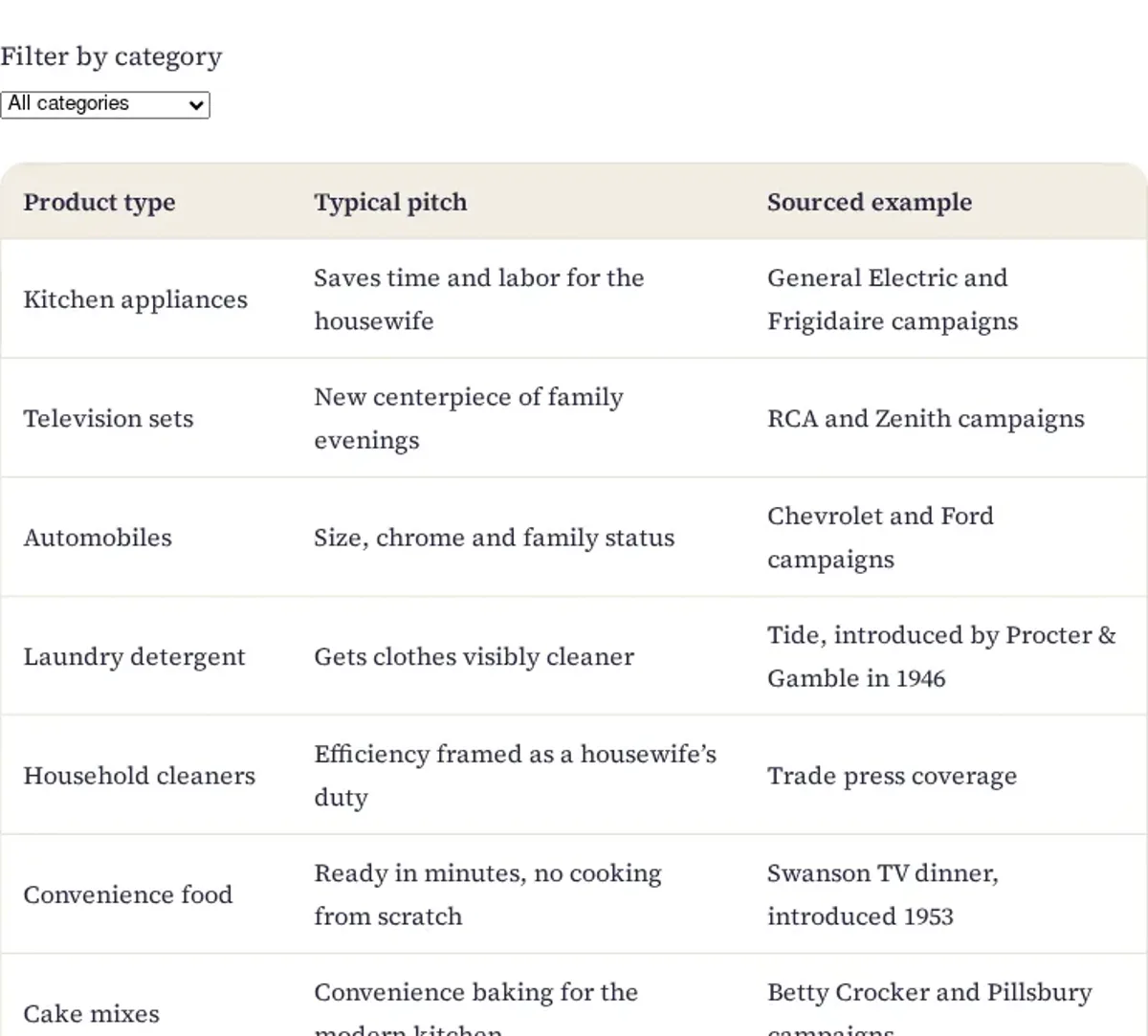
| Product type | Typical pitch | Sourced example |
|---|---|---|
| Kitchen appliances | Saves time and labor for the housewife | General Electric and Frigidaire campaigns |
| Television sets | New centerpiece of family evenings | RCA and Zenith campaigns |
| Automobiles | Size, chrome and family status | Chevrolet and Ford campaigns |
| Laundry detergent | Gets clothes visibly cleaner | Tide, introduced by Procter & Gamble in 1946 |
| Household cleaners | Efficiency framed as a housewife’s duty | Trade press coverage |
| Convenience food | Ready in minutes, no cooking from scratch | Swanson TV dinner, introduced 1953 |
| Cake mixes | Convenience baking for the modern kitchen | Betty Crocker and Pillsbury campaigns |
| Dessert mixes | Recipe-based convenience | Jell-O recipe-booklet advertising |
| Soft drinks | Family refreshment, promoted year-round | Coca-Cola “pause that refreshes” campaigns |
| Cigarettes (health claims) | Doctor endorsement used as a reassurance of safety | “More doctors smoke Camels” campaign |
| Cigarettes (repositioning) | Shift from a women’s brand to a masculine image | Marlboro Man campaign, from 1954 |
| Shapewear | Appearance and figure control | Women’s magazine advertising |
| Weight-loss products | Slimming and appearance claims aimed at women | Women’s magazine advertising |
| Life insurance | Providing for the family’s future | Trade press coverage |
| Children’s toys | Advertised directly to children on television | Mattel’s Barbie, introduced 1959 |
The category filter sorts the same table; every row keeps its original product type and example.
Print ads of the decade
Entries below list the brand and the year. Magazine and newspaper advertising in the 1950s leaned on large illustrated spreads rather than photography for most categories, built around a single family scene — a kitchen, a car, a living room with a new television set. The fifteen rows above span home goods, food, and personal and health products, each with its typical sales pitch.
How ads spoke to housewives
Table rows are listed below. Advertising for appliances, cleaners and packaged food in the 1950s was overwhelmingly addressed to women as household managers, framing a product’s time savings or cleaning power as a direct measure of care for the family. That pattern runs through most of the home and food rows in the table above, and is treated here as a historical fact about the era’s advertising, not a position on the roles it assumed.
Dates and credits come from public sources; report an error on the contact page.
Ads that would not run today
Each claim links to a public source. The clearest example sits in the cigarette rows above: brands ran doctor-endorsement advertising, such as “More doctors smoke Camels than any other cigarette,” as a direct reassurance of safety. That kind of health claim for tobacco ended after the 1964 United States Surgeon General’s report on smoking and health, which is outside this decade but explains why the practice stopped. The shapewear and weight-loss rows reflect appearance standards common to 1950s women’s magazines that a later decade’s advertising rules and norms would not run in the same form.

Learn more about StayFree and its coverage of American advertising history.
Updated 14 Nov 2026
Was this page helpful?
One tap tells us which guides need more detail.
Thanks for your feedback!