Famous slogans are short advertising lines that came to stand for a brand long after the campaign ended, sometimes outliving the products or the agencies that wrote them. Want more StayFree vintage advertisements? Browse the home page for other decades.
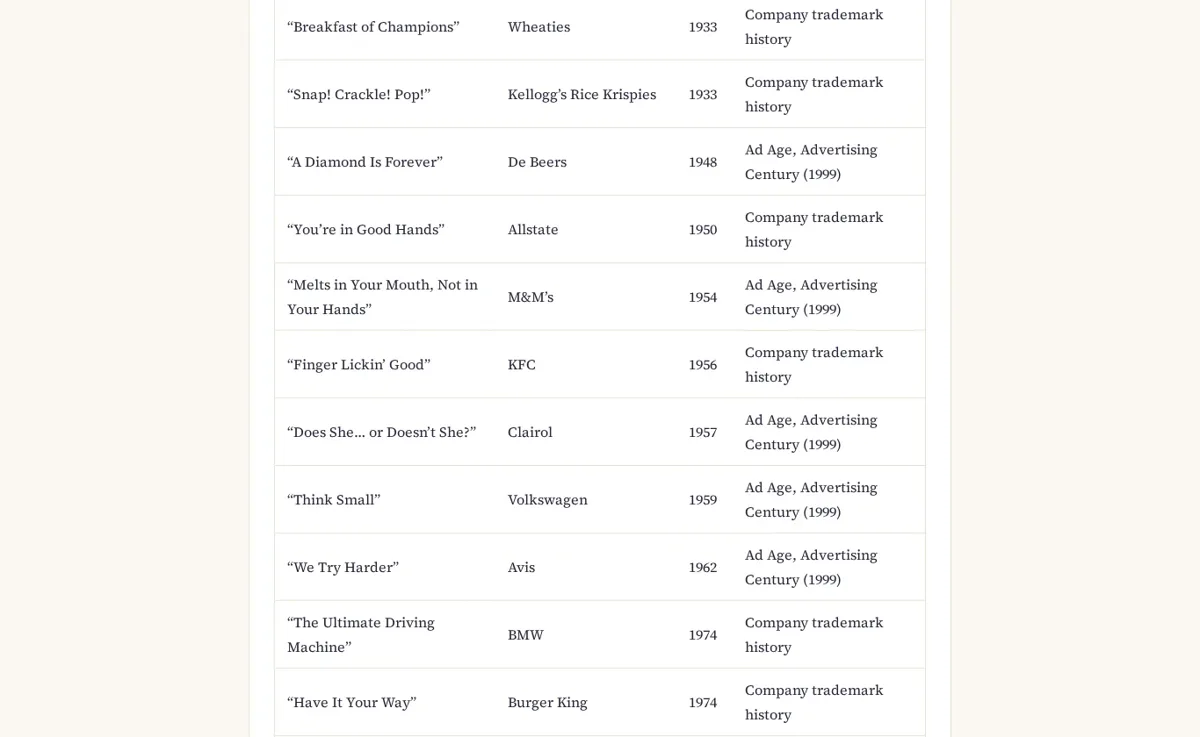
| Slogan | Brand | Year | Source |
|---|---|---|---|
| “When It Rains It Pours” | Morton Salt | 1911 | Company trademark history |
| “Breakfast of Champions” | Wheaties | 1933 | Company trademark history |
| “Snap! Crackle! Pop!” | Kellogg’s Rice Krispies | 1933 | Company trademark history |
| “A Diamond Is Forever” | De Beers | 1948 | Ad Age, Advertising Century (1999) |
| “You’re in Good Hands” | Allstate | 1950 | Company trademark history |
| “Melts in Your Mouth, Not in Your Hands” | M&M’s | 1954 | Ad Age, Advertising Century (1999) |
| “Finger Lickin’ Good” | KFC | 1956 | Company trademark history |
| “Does She… or Doesn’t She?” | Clairol | 1957 | Ad Age, Advertising Century (1999) |
| “Think Small” | Volkswagen | 1959 | Ad Age, Advertising Century (1999) |
| “We Try Harder” | Avis | 1962 | Ad Age, Advertising Century (1999) |
| “The Ultimate Driving Machine” | BMW | 1974 | Company trademark history |
| “Have It Your Way” | Burger King | 1974 | Company trademark history |
| “Because You’re Worth It” | L’Oréal | 1973 | Company trademark history |
| “Don’t Leave Home Without It” | American Express | 1975 | Company trademark history |
| “Reach Out and Touch Someone” | AT&T | 1979 | Company trademark history |
| “Where’s the Beef?” | Wendy’s | 1984 | Ad Age, Advertising Century (1999) |
| “Just Do It” | Nike | 1988 | Company trademark history |
| “Got Milk?” | California Milk Processor Board | 1993 | Company trademark history |
The decade filter sorts the same table; every row keeps its original brand and year.
Slogans by decade
Entries below list the brand and the year. Packaged-food slogans came first: Morton Salt’s “When It Rains It Pours” (1911) and Wheaties’ “Breakfast of Champions” (1933) both sold a promise rather than a product feature. The 1950s produced the largest cluster in the table above — “Think Small” for Volkswagen, “Melts in Your Mouth, Not in Your Hands” for M&M’s and “Does She… or Doesn’t She?” for Clairol all date to that decade, each built around one plain, repeatable claim.
The 1970s shifted toward direct instruction: “Have It Your Way” and “Don’t Leave Home Without It” both tell the reader what to do, not just what the brand believes. By the 1980s, a slogan phrased as a question — “Where’s the Beef?” for Wendy’s, 1984 — could carry a whole campaign on its own, helped by a TV spot that turned the line into a catchphrase outside advertising.
What made them stick
Table rows are listed below. Across the eighteen slogans in the reference table, three traits repeat: most are five words or fewer, most name a single clear benefit instead of several, and several use a question or command rather than a flat statement — “Where’s the Beef?”, “Got Milk?” and “Have It Your Way” all put the reader in the sentence instead of the brand.
Dates and credits come from public sources; report an error on the contact page.
Slogans brands later dropped
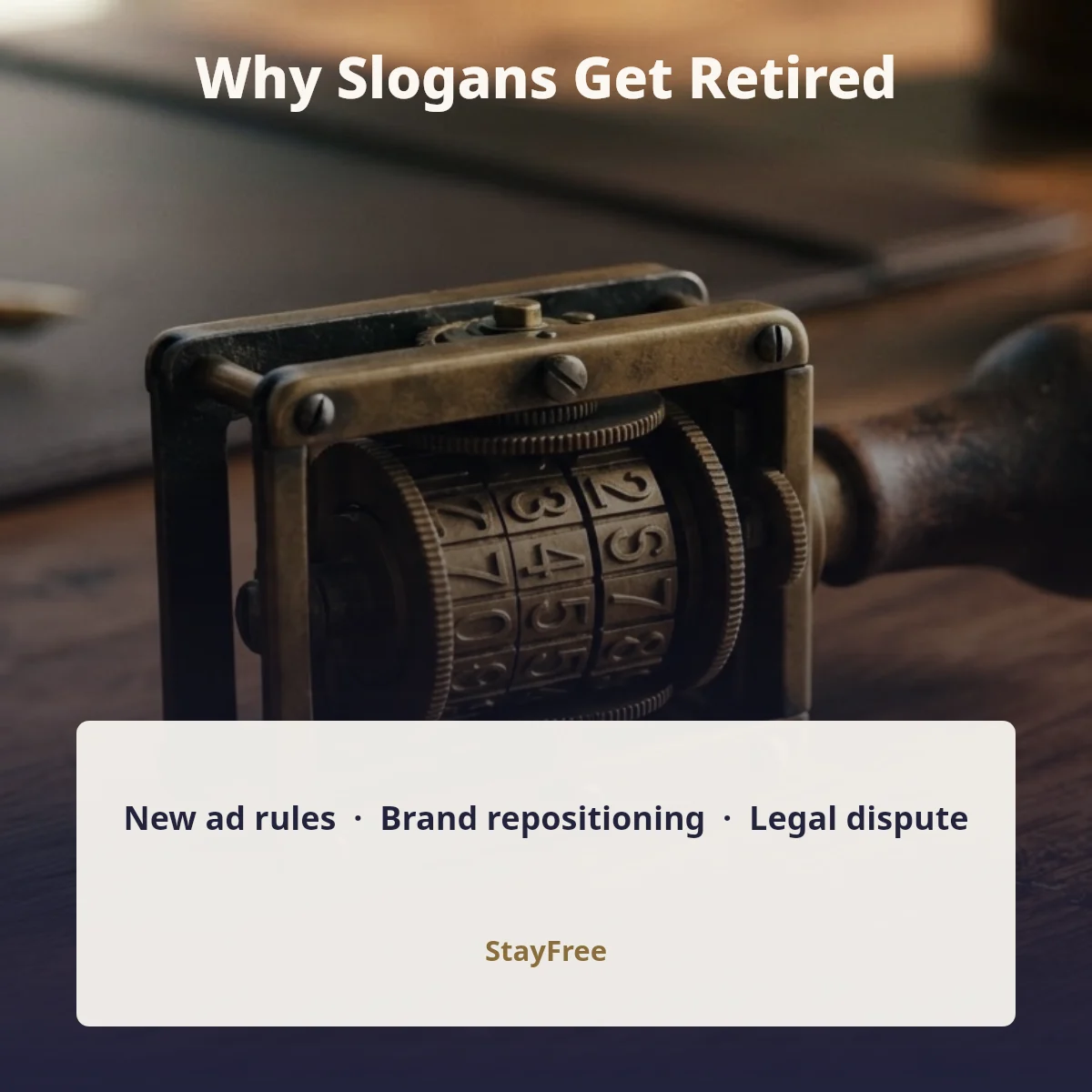
Each claim links to a public source. Cigarette brands lost their broadcast slogans outright: the Public Health Cigarette Smoking Act ended cigarette advertising on American television and radio starting January 1971, so lines built for TV spots disappeared from the air by regulation rather than by choice. Taco Bell’s “Yo Quiero Taco Bell” campaign, built around a talking Chihuahua, ended in 2000 after a lawsuit over who owned the idea behind the ads. AOL’s “You’ve Got Mail” slogan faded for a simpler reason: it was written for a dial-up email alert, and it had little left to say once broadband and smartphone notifications replaced that moment.
Updated 14 Nov 2026
Was this page helpful?
One tap tells us which guides need more detail.
Thanks for your feedback!