1920s advertisements grew alongside mass-circulation magazines and the first commercial radio broadcasts, teaching Americans to recognize and ask for brands by name instead of buying plain, unbranded goods off a store shelf. Want more StayFree vintage advertisements? Browse the home page for other decades.
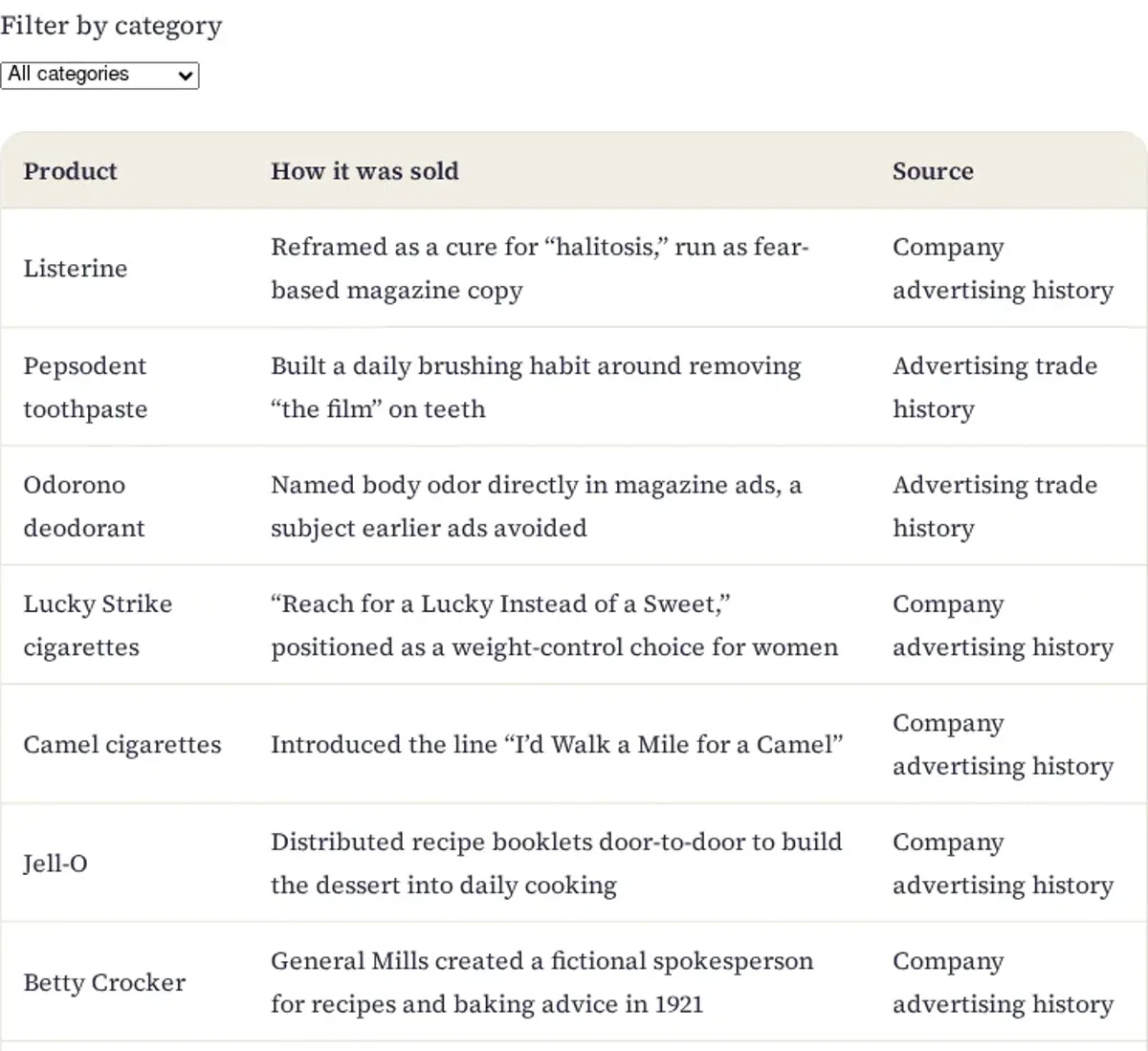
| Product | How it was sold | Source |
|---|---|---|
| Listerine | Reframed as a cure for “halitosis,” run as fear-based magazine copy | Company advertising history |
| Pepsodent toothpaste | Built a daily brushing habit around removing “the film” on teeth | Advertising trade history |
| Odorono deodorant | Named body odor directly in magazine ads, a subject earlier ads avoided | Advertising trade history |
| Lucky Strike cigarettes | “Reach for a Lucky Instead of a Sweet,” positioned as a weight-control choice for women | Company advertising history |
| Camel cigarettes | Introduced the line “I’d Walk a Mile for a Camel” | Company advertising history |
| Jell-O | Distributed recipe booklets door-to-door to build the dessert into daily cooking | Company advertising history |
| Betty Crocker | General Mills created a fictional spokesperson for recipes and baking advice in 1921 | Company advertising history |
| Coca-Cola | Ran seasonal “Thirst Knows No Season” copy to sell the drink outside summer | Company advertising history |
| Wrigley’s gum | Expanded heavily into outdoor billboard advertising | Advertising trade history |
| Ford Model T | Marketed as “the Universal Car,” selling price and reliability over style | Company advertising history |
| RCA Radiola | Sold home radio sets as a must-have as broadcast stations multiplied | Company advertising history |
| Palmolive soap | “Keep That Schoolgirl Complexion,” sold soap as a beauty routine | Company advertising history |
| Woodbury’s Facial Soap | “A Skin You Love to Touch,” one of the earliest ads to use romantic appeal for soap | Advertising trade history |
| Lux Soap Flakes | Used actress endorsements to sell flakes for washing clothes and stockings | Company advertising history |
| B.V.D. underwear | Moved from plain product description to repeated brand-name copy | Advertising trade history |
The category filter sorts the same table; every row keeps its original product and source.
How ads changed in the 1920s
Entries below list the brand and what changed in its approach. Magazine circulation and radio ownership both grew quickly through the decade, giving advertisers a national audience for the first time. Copy shifted from plain product description, “made of good material,” toward naming a specific worry or desire the product could fix — the pattern behind Listerine’s halitosis campaign and Pepsodent’s “film on your teeth” line, both listed in the table above.
Examples by product
Table rows are listed below. The fifteen products above span health and hygiene, food, home goods and fashion, and each row names the specific sales approach the brand used rather than a general description of the ad.
Dates and credits come from public sources; report an error on the contact page.
Advertising and the new consumer
Each claim links to a public source. Listerine’s 1920s advertising is the clearest case of the shift: the product itself did not change, but the copy around it did, turning an existing mouthwash into a response to a named social fear. That pattern — naming a worry a reader did not previously have a word for, then offering the product as the fix — became common across the health and hygiene rows in the table above, and marks a break from the earlier style of simply describing what a product was made of.

Learn more about StayFree and its coverage of American advertising history.
Updated 14 Nov 2026
Was this page helpful?
One tap tells us which guides need more detail.
Thanks for your feedback!